A Practical Guide for Designers, Product Thinkers & AI Professionals
A Practical Guide for Designers, Product Thinkers & AI Professionals
Learn to Think Like a World-Class Designer in the Age of AI
Learn to Think Like a World-Class Designer in the Age of AI
Learn to Think Like a World-Class Designer in the Age of AI
AI can generate interfaces, wireframes, and even prototypes in seconds. But it still can't replace human judgment, empathy, critical thinking, or purpose-driven design.
The Universal Design Mindset brings together design thinking, psychology, cognitive science, behavioral design, product strategy, and AI to help you build products that people truly value—not just beautiful screens.
AI can generate interfaces, wireframes, and even prototypes in seconds. But it still can't replace human judgment, empathy, critical thinking, or purpose-driven design.
The Universal Design Mindset brings together design thinking, psychology, cognitive science, behavioral design, product strategy, and AI to help you build products that people truly value—not just beautiful screens.
Get the Book
Get the Book
Free Preview
Free Preview
320+
Pages
320+
Pages
30+
Chapters
30+
Chapters
100+
Practical Frameworks
100+
Practical Frameworks
100+
Practical Frameworks
30+
Design Principles
30+
Design Principles

The Problem
The Problem
You were taught the tools. Nobody taught you the thinking.
You were taught the tools. Nobody taught you the thinking.
You were taught the tools. Nobody taught you the thinking.
Most design education optimizes for software fluency — which button, which panel, which plugin. It rarely explains why a layout works, why a user hesitates, or why one interface feels inevitable and another feels like guesswork.
Most design education optimizes for software fluency — which button, which panel, which plugin. It rarely explains why a layout works, why a user hesitates, or why one interface feels inevitable and another feels like guesswork.
01 — The Skill Gap
01 — The Skill Gap
You can operate the tools. You can't always defend the decision.
You can operate the tools. You can't always defend the decision.
Aspiring designers learn how to create long before they understand why a design choice actually works. The result: portfolios full of polish, and interviews full of "I just felt like it looked right."
Aspiring designers learn how to create long before they understand why a design choice actually works. The result: portfolios full of polish, and interviews full of "I just felt like it looked right."
02 — The AI Uncertainty
02 — The AI Uncertainty
AI can now generate a landing page in seconds. So where does that leave you?
AI can now generate a landing page in seconds. So where does that leave you?
It's a reasonable fear. AI is compressing timelines, reshaping entry-level work, and producing output that looks competent at first glance. Pretending that isn't happening doesn't protect anyone from it.
It's a reasonable fear. AI is compressing timelines, reshaping entry-level work, and producing output that looks competent at first glance. Pretending that isn't happening doesn't protect anyone from it.
"Speed is not wisdom. Generation is not judgment. Prediction is not understanding. The value of a designer has never been the ability to move pixels faster than everyone else."
"Speed is not wisdom. Generation is not judgment. Prediction is not understanding. The value of a designer has never been the ability to move pixels faster than everyone else."
— Chapter 30, Skills AI Cannot Replace
— Chapter 30, Skills AI Cannot Replace
— Chapter 30, Skills AI Cannot Replace
The Future of Design
The Future of Design
AI is changing the tools. It isn't changing why designers matter.
AI is changing the tools. It isn't changing why designers matter.
AI is changing the tools. It isn't changing why designers matter.
As machines get faster at execution, the human skills underneath — judgment, taste, empathy, strategy — become the entire job. This book was written to make sure you're building those, on purpose.
As machines get faster at execution, the human skills underneath — judgment, taste, empathy, strategy — become the entire job. This book was written to make sure you're building those, on purpose.
Strategy
Strategy
Solving the right problem
Solving the right problem
AI can help answer questions. It can't reliably tell you whether the question itself is the right one to be asking.
AI can help answer questions. It can't reliably tell you whether the question itself is the right one to be asking.
Taste
Taste
Knowing what good looks like
Knowing what good looks like
AI generates from patterns it has seen before. It has no aesthetic judgment — no sense of why one solution feels timeless and another feels dated.
AI generates from patterns it has seen before. It has no aesthetic judgment — no sense of why one solution feels timeless and another feels dated.
Empathy
Empathy
Understanding what people feel
Understanding what people feel
AI can recognize emotional language. It can't sit with hesitation, confusion, or relief the way a designer who's paying attention can.
AI can recognize emotional language. It can't sit with hesitation, confusion, or relief the way a designer who's paying attention can.
"When AI can produce the surface of design in minutes, the human who understands what lies beneath it — the psychology, the ethics, the strategic purpose — is the only person in the room who knows whether the output is actually any good."
"When AI can produce the surface of design in minutes, the human who understands what lies beneath it — the psychology, the ethics, the strategic purpose — is the only person in the room who knows whether the output is actually any good."
Why Most Designers Stay Average
Why Most Designers Stay Average
Why Most Designers Stay Average
Tactical designers redesign screens. Strategic designers ask why the screen exists at all.
Tactical designers redesign screens. Strategic designers ask why the screen exists at all.
Tactical designers redesign screens. Strategic designers ask why the screen exists at all.
A company asks for a redesigned app. Most designers open Figma. The book teaches you to ask a harder question first: is the app even the problem?
A company asks for a redesigned app. Most designers open Figma. The book teaches you to ask a harder question first: is the app even the problem?
The Average Designer
The Average Designer
Starts with the interface, not the problem
Starts with the interface, not the problem
Measures success by how polished it looks
Measures success by how polished it looks
Treats deliverables as the finish line
Treats deliverables as the finish line
Learns tools faster than principles
Learns tools faster than principles
Feels threatened by what AI can now produce
Feels threatened by what AI can now produce
The designer this book builds
The designer this book builds
Starts with "what change are we trying to create?"
Starts with "what change are we trying to create?"
Measures success by outcomes, not outputs
Measures success by outcomes, not outputs
Treats deliverables as one expression of a solution
Treats deliverables as one expression of a solution
Learns principles that outlast every tool
Learns principles that outlast every tool
Uses AI as an amplifier, not a threat
Uses AI as an amplifier, not a threat
Introducing the Book
Introducing the Book
Introducing the Book
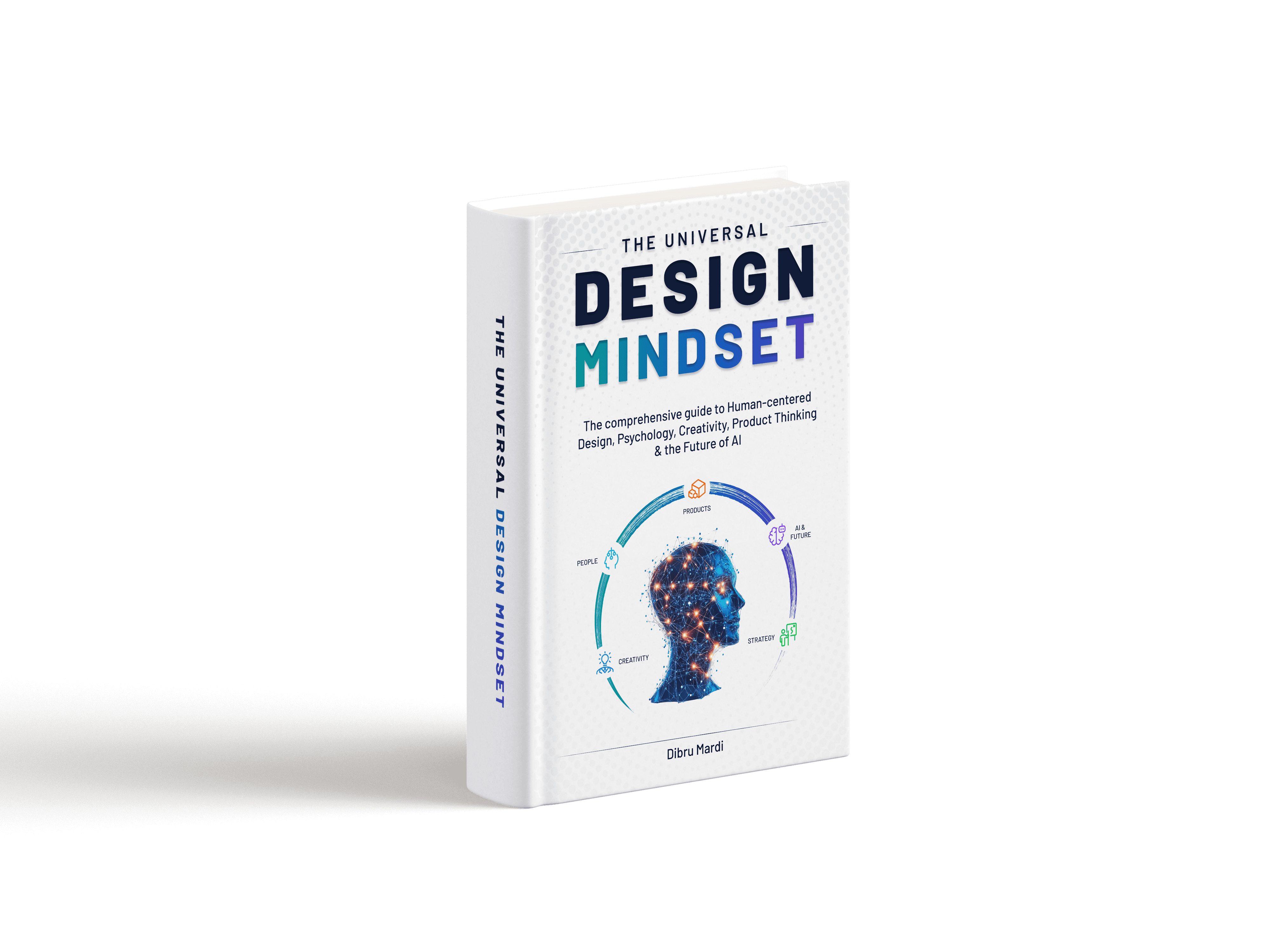
One mindset. Every design discipline. Built to outlast the tools.
One mindset. Every design discipline. Built to outlast the tools.
One mindset. Every design discipline. Built to outlast the tools.
This isn't another UI tutorial or Figma guide.
Whether you design mobile apps, fashion, photography, film, or brand systems, the fundamentals are the same: understand people, then create something that improves their lives.
It's a comprehensive framework for understanding how people think, perceive, decide, and behave—and how AI fits into that future.
This isn't another UI tutorial or Figma guide.
Whether you design mobile apps, fashion, photography, film, or brand systems, the fundamentals are the same: understand people, then create something that improves their lives.
It's a comprehensive framework for understanding how people think, perceive, decide, and behave—and how AI fits into that future.
Get the Book
Get the Book
Free Preview
Free Preview
8
Parts
8
Parts
30+
Chapters
30+
Chapters
100+
Practical Frameworks
100+
Practical Frameworks
100+
Practical Frameworks
5
Appendices
5
Appendices
What's Inside
What's Inside
Eight parts. One continuous argument.
Eight parts. One continuous argument.
Eight parts. One continuous argument.
Click any part to see what's covered, chapter by chapter.
Click any part to see what's covered, chapter by chapter.
Click any part to see what's covered, chapter by chapter.
Part 1
Ch 1 - 3
The Foundation of Design
Part 1
Ch 1 - 3
The Foundation of Design
Part 2
Ch 4 - 7
How Humans Experience the World
Part 2
Ch 4 - 7
How Humans Experience the World
Part 3
Ch 8 - 11
Universal Principles of Design
Part 3
Ch 8 - 11
Universal Principles of Design
Part 4
Ch 12 - 15
Creativity & Innovation
Part 4
Ch 12 - 15
Creativity & Innovation
Part 5
Ch 16 - 20
Human-Centered Product Design
Part 5
Ch 16 - 20
Human-Centered Product Design
Part 6
Ch 21 - 25
Product Thinking & Business Design
Part 6
Ch 21 - 25
Product Thinking & Business Design
Part 7
Ch 26 - 32
The AI Era
Part 7
Ch 26 - 32
The AI Era
Part 8
Ch 33 - 35
The Future of Design
Part 8
Ch 33 - 35
The Future of Design
Appendix A
Recommended reading and resources by design field
Appendix B
The 30 design laws at a glance (quick reference)
Appendix C
AI tool directory for designers (with use cases)
Appendix D
Prompt library: 50 tested prompts for design workflows
Appendix E
Glossary of terms across all design fields
Who This Book Is For
Who This Book Is For
Written for two readers — honestly, from the first page.
Written for two readers — honestly, from the first page.
Written for two readers — honestly, from the first page.
Reader One
Reader One
Reader One
If you're early in your design journey
If you're early in your design journey
UX, graphic design, fashion, photography, film, or any other creative discipline — Parts One through Five are your foundation. No prior design education required.
UX, graphic design, fashion, photography, film, or any other creative discipline — Parts One through Five are your foundation. No prior design education required.
You need curiosity, not credentials
You need curiosity, not credentials
You'll build the vocabulary experienced designers use intuitively
You'll build the vocabulary experienced designers use intuitively
You'll learn principles before you learn to depend on any one tool
You'll learn principles before you learn to depend on any one tool
Reader Two
Reader Two
Reader Two
If you've already shipped products and led teams
If you've already shipped products and led teams
Parts One through Five will sharpen and name things you already know intuitively. Part Six speaks directly to the professional questions keeping you up at night.
Parts One through Five will sharpen and name things you already know intuitively. Part Six speaks directly to the professional questions keeping you up at night.
The AI section isn't written for beginners discovering what a design tool is
The AI section isn't written for beginners discovering what a design tool is
It's written for people who've built a craft and want a clear-eyed view of what's next
It's written for people who've built a craft and want a clear-eyed view of what's next
No panic, no false reassurance — just clarity
No panic, no false reassurance — just clarity
What You'll Learn
What You'll Learn
Six areas of mastery, built to compound.
Six areas of mastery, built to compound.
Six areas of mastery, built to compound.
01
Human psychology
Human psychology
How the brain processes information, perceives, and decides — and what that means for every screen and surface you design.
How the brain processes information, perceives, and decides — and what that means for every screen and surface you design.
02
Universal design laws
Universal design laws
Hick's Law, Fitts's Law, the Peak-End Rule, and 27 more — the named principles behind every strong design decision.
Hick's Law, Fitts's Law, the Peak-End Rule, and 27 more — the named principles behind every strong design decision.
03
Creativity as a practice
Creativity as a practice
How to find ideas everywhere, run a real creative process, and get unstuck when the well runs dry.
How to find ideas everywhere, run a real creative process, and get unstuck when the well runs dry.
04
Product & business thinking
Product & business thinking
Lean UX, the metrics designers should understand, and how to work with stakeholders who don't speak design.
Lean UX, the metrics designers should understand, and how to work with stakeholders who don't speak design.
05
Designing with AI
Designing with AI
Prompt engineering for designers, a new AI-native workflow, and how to design AI products responsibly.
Prompt engineering for designers, a new AI-native workflow, and how to design AI products responsibly.
06
What stays uniquely human
What stays uniquely human
Strategic thinking, taste, empathy, and leadership — the skills AI amplifies but can never replace.
Strategic thinking, taste, empathy, and leadership — the skills AI amplifies but can never replace.

About the Author
About the Author
Dibru Mardi
Dibru Mardi
Dibru Mardi
Dibru is a User Experience Designer with experience designing digital products across multiple domains, including fintech, AI-powered platforms, analytics systems, and consumer-facing applications.
Over the years, he's worked closely with product managers, engineers, researchers, business stakeholders, and end users to solve complex problems through design — the experiences that shaped every perspective in this book.
"I remain a student of design. The lessons in these pages are not presented as absolute truths, but as principles and frameworks that have consistently helped me create better products and make better design decisions."
Dibru is a User Experience Designer with experience designing digital products across multiple domains, including fintech, AI-powered platforms, analytics systems, and consumer-facing applications.
Over the years, he's worked closely with product managers, engineers, researchers, business stakeholders, and end users to solve complex problems through design — the experiences that shaped every perspective in this book.
"I remain a student of design. The lessons in these pages are not presented as absolute truths, but as principles and frameworks that have consistently helped me create better products and make better design decisions."
Fintech
AI Platforms
Analytics
Consumer Apps
UX Strategy
Book Preview
Book Preview
Read the opening of Chapter 1, free.
Read the opening of Chapter 1, free.
Read the opening of Chapter 1, free.
P.10
P.10
P.10
-
-
-
-
-
-
-
-
-
-
-
-
-
-
-
P.16
P.16
P.16
Continues in Chapter 1 ---------------------------------————-----—---------------34 chapters remain
—————————--34 chapters remain
Continues in Chapter 1 ---------------------——-34 chapters remain
Get the Full Book
Get the Full Book
Early Reader Reviews
Early Reader Reviews
What early readers are saying.
What early readers are saying.
What early readers are saying.
"I've read a dozen design books. This is the first one that connected psychology, business, and AI into a single way of thinking instead of three separate lectures."
"I've read a dozen design books. This is the first one that connected psychology, business, and AI into a single way of thinking instead of three separate lectures."

Molly Hellmuth
Molly Hellmuth
Product Designer at Cred
Product Designer at Cred
"Chapter 9 alone is worth the price — I keep the 30 design laws open in a tab during every critique now."
"Chapter 9 alone is worth the price — I keep the 30 design laws open in a tab during every critique now."

John Doe
John Doe
Product Designer at UI Prep
Product Designer at UI Prep
"The AI chapters are the calmest, most useful thing I've read on the topic. No hype, no doom — just what to actually build."
"The AI chapters are the calmest, most useful thing I've read on the topic. No hype, no doom — just what to actually build."

Allen Smith
Allen Smith
Product Manager
Product Manager
Pricing
Pricing
Get the mindset that outlasts every tool.
Get the mindset that outlasts every tool.
Get the mindset that outlasts every tool.
One-time payment. Instant access. Read on any device.
One-time payment. Instant access. Read on any device.
Free Preview
Free Preview
Try it before you buy it
Try it before you buy it
Try it before you buy it
₹0
₹0
₹0
INR
INR
|
|
One-time
One-time
Preview in PDF format
Preview in PDF format
2 Chapters
2 Chapters
21 Pages
21 Pages
Free updates for every future edition
Free updates for every future edition
Free Preview
Free Preview
Complete Edition
Complete Edition
The book, on its own
The book, on its own
The book, on its own
40% Off
40% Off
₹1999
₹1999
₹1199
₹1199
₹1199
INR
INR
|
One-time
One-time
Full ePub + PDF, 322 pages
Full ePub + PDF, 322 pages
35 chapters across 8 parts
35 chapters across 8 parts
5 appendices, incl. the 30 design laws
5 appendices, incl. the 30 design laws
Free updates for every future edition
Free updates for every future edition
Buy Full Edition
Buy Full Edition
Secure payment with Lemon Squeezy
Secure payment with Lemon Squeezy






FAQs
FAQs
Questions before you buy.
Questions before you buy.
Questions before you buy.
If you have any other questions or feedback, contact me and I’ll get back to you shortly.
If you have any other questions or feedback, contact me and I’ll get back to you shortly.
If you have any other questions or feedback, contact me and I’ll get back to you shortly.
What format does the book come in?
You'll get both ePub and PDF, so it reads well on phones, tablets, e-readers, and desktop. Optimized for both quick reference and cover-to-cover reading.
What format does the book come in?
Do I need design experience to read this?
No. Parts One through Five are written to need no prior design education — just curiosity. If you're an experienced designer, those same parts will sharpen what you already know, and Part Six speaks directly to you.
Do I need design experience to read this?
Will the AI content be out of date by the time I read it?
The AI-specific chapters (Part 7 & 8) focus on workflows and judgment rather than any single tool, so they age slower than a tutorial. The Complete Edition also includes free updates for every future edition.
Will the AI content be out of date by the time I read it?
Is this only for UX/UI designers?
No — the principles apply across UX, graphic design, fashion, photography, film, architecture, and any field where you're solving problems for people. The psychology and design-law chapters are discipline-agnostic.
Is this only for UX/UI designers?
Is there a refund policy?
Yes — a 14-day money-back guarantee, no questions asked.
Is there a refund policy?
Before you Go
Before you Go
"Before you are a UX designer, or a graphic designer, or a Product manager — you are a problem solver."
"Before you are a UX designer, or a graphic designer, or a Product manager — you are a problem solver."
"Before you are a UX designer, or a graphic designer, or a Product manager — you are a problem solver."
The Universal Design Mindset is the foundation for that responsibility. Start reading today.
The Universal Design Mindset is the foundation for that responsibility. Start reading today.
The Universal Design Mindset is the foundation for that responsibility. Start reading today.
Get the Book - ₹1199
Get the Book - ₹1199